
Ethan Frome
On suffering without end

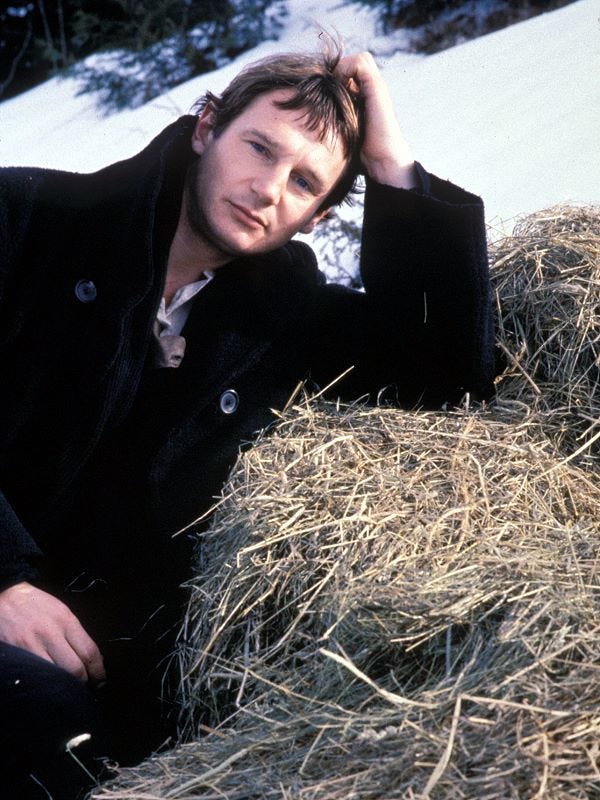
Happy Thursday! I hope everyone has had a good week. This week I read Ethan Frome, the short novel (it’s really almost more of a short story) by Edith Wharton. Real HoosierCath heads will know that I read her House of Mirth last month. I have been struck by her unsentimental nature. Her characters are not given the cheap grace of a redemption at the end of the story, which lets you off the hook so that you never really have to grapple with the ways in which the protagonists’ life goes wrong. In The House of Mirth, there are all these ways in which Lily Bart’s life could have gone right, if only she had stopped dallying and self-destructing, thinking that she would have an endless summer.
Here, Ethan’s life is even more bleak. As a youth, he wished to move out of Starkfield, Massachusetts, but his parents got sick. A young woman, Zeena, comes to Starkfield and cares for Ethan’s mother. After his mother dies, he proposes to Zeena, only to find her unwilling to leave Starkfield and laid up with constant maladies, which strain his already-meager income. They take in a relative of Zeena’s, Mattie, with whom Ethan falls in love. Zeena departs for a doctor’s trip, during which Mattie and Ethan discover that their love is reciprocated. When Zeena returns, she sends away Mattie in favor of a hired girl (it is not clear, but likely, that Zeena suspected something). Distraught, Ethan and Mattie go for a sleigh ride together, during which they make a suicide pact and run into a great big elm.
In a cruel twist of fate, neither Mattie nor Ethan die. Instead, we find out in the last few pages that they survive with permanent injuries, and Zeena reverses her role into that of caretaker, caring for Mattie for decades. The whole town knows that there was a forbidden dalliance on that sleigh ride together, and all three spend the rest of their lives suffering, largely isolated from the town. There is no reprieve, not even the reprieve of death.
Structurally, the story of Ethan and Mattie is bookended by an unnamed narrator visiting Starkfield. He hears parts of the story elliptically from various townsfolk, before he is snowed in at Ethan’s. Then the narrative cuts to the whole story of Ethan’s youth, decades prior. After the crash at the elm tree, the book concludes with the narrator being told about the three of them living together in misery. I liked this device when I first encountered, and was mildly disappointed when it only lasted for the introduction. It would have been interesting (but a fundamentally different book) if the whole story was told second-hand to the narrator.
As you can see, this is not a happy book. What struck me about this book was how the Norman Rockwell picture of bucolic country life almost seems to be happening in parallel to Ethan’s life. The opening of the flashback involves Ethan looking in on a country dance, where Mattie is joyfully dancing with Denis, the son of a prosperous grocer. There is a point where we see Denis going on a (non-tragic) sleigh ride, and invites Mattie. Towards the end of the novel, Ethan visits the store and sees Denis holding court with the town’s golden youth. Even when Ethan visits Mr. Hale, to whom he sells his lumber, Mr. Hale pleads delay on payment because he has to build an extension for one of his kids’ marriage. If Denis were the subject of the book, the readers would be suffused with a warm glow by the end of it.
Throughout this book, we see a completely different Starkfield than Ethan’s. We have no reason to believe that Denis will live anything other than a perfectly happy life, full of the revelry of a nice country Christmas poem. And yet, Ethan is bound by a sick wife and a failing farm. He is like the parents in Stoner, who are beaten down by life until they are buried under the ground they till. In fact, there is a scene with the graves of his ancestors, which lie on his property, which he apparently contemplates often.
And yet, there is no great message. There isn’t much sense of lurid passion; even the love scenes between Ethan and Mattie feel somewhat sparse. Ethan isn’t a noble man fighting against the forces of the universe; there’s no nobility in his struggle. He just gets a little poorer and his farm gets a little shabbier each year.
If there is nobility here, it’s the very thing that keeps him from being happy. There’s a moment where he imagines going West with his lover, letting Zeena divorce him, and then remarrying and making some money. Apparently at least one man of Starkfield has done this, and by all accounts is perfectly happy. And yet, his farm is mortgaged up to the water line. If he left, he would be leaving Zeena destitute. He goes to the aforementioned Mr. Hale and almost asks for a loan. This would ostensibly be for Zeena’s care (because he knows Mr. Hale is too good of a man to say no), but he decides he can’t deceive Mr. Hale like that. With all the even minimally honorable options exhausted, he is resigned to never seeing Mattie again, culminating in the aforementioned suicide attempt.
As I said, I am not sure that there is a silver lining, and I suspect that to be the point. Mrs. Wharton is not exactly a sentimental author. It reminded me of the downward spiral of Saul Bellow’s Seize the Day, another (albeit very different) novella about the low point of a modern man. That novella, which has more pointed commentary about the modern man and his attempts to avoid confronting himself, is about a man who has been swindled out of the last of his money in the hopes of a big stock market return. In both of these novellas, the downfall is telegraphed pretty early. You know Ethan is alive in Starkfield decades later, injured in a sleigh accident. So, you know the whole time that Ethan is not going to move West or down to Florida like he wanted. The reader doesn’t even have any hopes to be dashed.
I will say that Wharton does a good job of writing the characters and the scenes. The lack of passion of the characters really is evocative of cold, stoic New Englanders. The writing itself feels very sparse as well, in a way that adds to the descriptions of rural Massachusetts. It is stylistically very evocative, and that is a point in its favor. I also did enjoy the narrative device, though I wish it were consistent. Around 2/3 of the way through, it really picks up momentum, such that I read most of it in one sitting. The end of the book will be one you don’t want to put down, if only to see how the fateful sleigh ride comes about.
All in all, I think I preferred House of Mirth. I suspect that might be because I prefer the idea of a life that went wrong from choice to the one from which there was no escape. Lily Bart died because she didn’t understand the reality of her situation; Ethan Frome lived, though he knew his reality all too well.
That’s all for this week. On Sunday I will probably write something about the difference in the individual good and the good of the ideal polis, which I think is a recurring philosophical problem. I think Plato, Aristotle, and Christians all try to answer this problem differently. Watch this space.